
Red Hong Yi on Motherhood, Art & the Making of Her Latest Solo Exhibition: I’m a Mum?!

Red Hong Yi has always been drawn to the quiet drama of the everyday. Trained in architecture and shaped by the pace and experimentation of Shanghai in 2011, she began making art out of ordinary objects in extraordinary volume. Repetition as language, material as story, the familiar reassembled into something emotionally charged.
That instinct soon became a career. After posting her work online in 2012, commissions began arriving from around the world. Along the way came the kind of surreal milestones that still feel impossible on paper: being invited to meet Jackie Chan, then creating his portrait from chopsticks; later, designing a TIME magazine cover artwork — a world map built from 20,000 burning green-tipped matchsticks — a “pinch-me” moment that brought her unconventional practice onto a global stage.
Now, Red is in her most personal chapter yet. She’s a mother of two — a 2.5-year-old boy and a 5-month-old daughter — and she describes motherhood as a force that expanded her heart, softened her, and made her feel time more sharply. It has also reshaped her creative instincts: she found herself pulled toward textiles and embroidery, drawn to stitching as a tender metaphor for mending, repairing, and piecing things back together by hand.
Her solo exhibition, I’m a Mum?!, is on now at Cultprint in George Town, Penang, running from 10 May to 12 July. The show explores early motherhood in all its emotional contradiction: the shock and tenderness, humour and exhaustion, love and loneliness that can exist in the same breath. In one of the interview’s most resonant moments, Red reflects on how motherhood has shifted her artistic presence: “Before becoming a mother, I sometimes felt pressure to appear more composed or certain. Now I’m more comfortable sitting in complexity and contradiction.”
In this Luminary Mothers conversation, Red opens up about identity shifts, guilt and grace, ambition and integration — and why being an artist and being a mother are not competing selves, but intertwined ones.
By Alice Codford
ON MOTHERHOOD
Alice: Do you feel that motherhood has changed you? In what ways?
Red Hong Yi: So much. I now have a 2.5-year-old boy and a 5-month-old daughter, and I smile whenever I think about them. In fact, I’m smiling right now.
Before I had children, I wondered what that kind of love would feel like, and whether I could really love the way I imagined a mother should. For many years, I wasn’t even sure if I wanted biological children. I always knew I wanted to nurture and care for others in some way, but I questioned what it meant to bring children into this world.
I still don’t think I have perfect answers to that. But what I do know is that motherhood has expanded my heart in ways I never expected. I think about my children constantly now - in the decisions I make, the way I move through the world, and even in the art I create. They’ve made me softer, more emotional, more patient, and also more aware of how precious and fleeting time is.
Is motherhood what you expected? What’s been the most unexpected part?
Red Hong Yi: Yes and no. Before I gave birth to my first child, my own mother told me that parenting would be the hardest thing I’d ever do, so I knew it wasn’t going to be a walk in the park! And especially with my first child, the early days and months were very difficult emotionally. I struggled with the huge identity shift and wondered if life would ever feel the same again.
What surprised me most was how all-consuming motherhood is - physically, mentally, emotionally. Your body, time, sleep, thoughts… everything changes overnight. I remember feeling shocked at how relentless it could feel in the beginning.
But at the same time, I also didn’t expect this much joy, tenderness, and sense of purpose. I didn’t expect to find so much wonder in such small everyday moments: hearing my toddler laugh uncontrollably, watching my baby discover her hands, seeing them learn words or react to the world with such curiosity.
Motherhood has made me feel both more vulnerable and stronger at the same time. It’s exhausting, repetitive, emotional, and sometimes overwhelming - but it has also been one of the most meaningful experiences of my life. I feel a deep sense of responsibility too, not just to care for my children, but to raise them with love, empathy, curiosity, and emotional safety.
“Motherhood has made me feel both more vulnerable and stronger at the same time. It’s exhausting, repetitive, emotional, and sometimes overwhelming - but it has also been one of the most meaningful experiences of my life.”
How has becoming a mother influenced the way you see yourself, both as a person and as an artist?
Red Hong Yi: I’m actually preparing for a solo exhibition about motherhood as I’m typing this! It’s titled “I’m a Mum?!” and explores the early days of motherhood - the shock, tenderness, exhaustion, identity shift, humour, and overwhelming love that can all exist at once.
Before having children, I think I subconsciously absorbed a very polished image of motherhood - something soft-focused, graceful, and instinctive. But when I became a mother myself, I realised how emotionally complex and disorienting it can be too. What really helped me through those early months were honest stories from other mothers. Not perfect stories - real ones.
As a person, I think motherhood has made me softer, more empathetic, and more emotionally open. I look at people now and think – that’s someone’s child!
As an artist, it made me want to create work that felt more emotionally truthful. I wanted to portray motherhood not as an idealised image, but as something deeply human: the joy and grief, love and loneliness, tenderness and frustration existing in the same breath.
Motherhood is often described as both transformative and grounding. What have been the most surprising lessons for you in this new chapter?
Red Hong Yi: That I’m apparently able to tolerate my children’s poop! Before becoming a mother, I genuinely wondered how I was ever going to wipe my kids’ butts or deal with bodily fluids all day. And now it’s just… normal life.
But beyond that, I think the most surprising thing has been how observant and emotionally aware babies and toddlers are from such a young age. My 5-month-old already lights up when she senses we’re about to head out somewhere, and I’m constantly amazed by how much my toddler notices, absorbs, and remembers.
It’s made me realise how deeply children learn through observation. My son picks up my expressions, phrases, gestures, and even tiny mannerisms that I’m not conscious of at all. Sometimes he says or does something and I suddenly realise, “Oh no… that’s me!”
Photographer Credit: Annice Lyn
Your art has always felt deeply emotional and intuitive, has motherhood changed your creative instincts or the way you express emotion through your work?
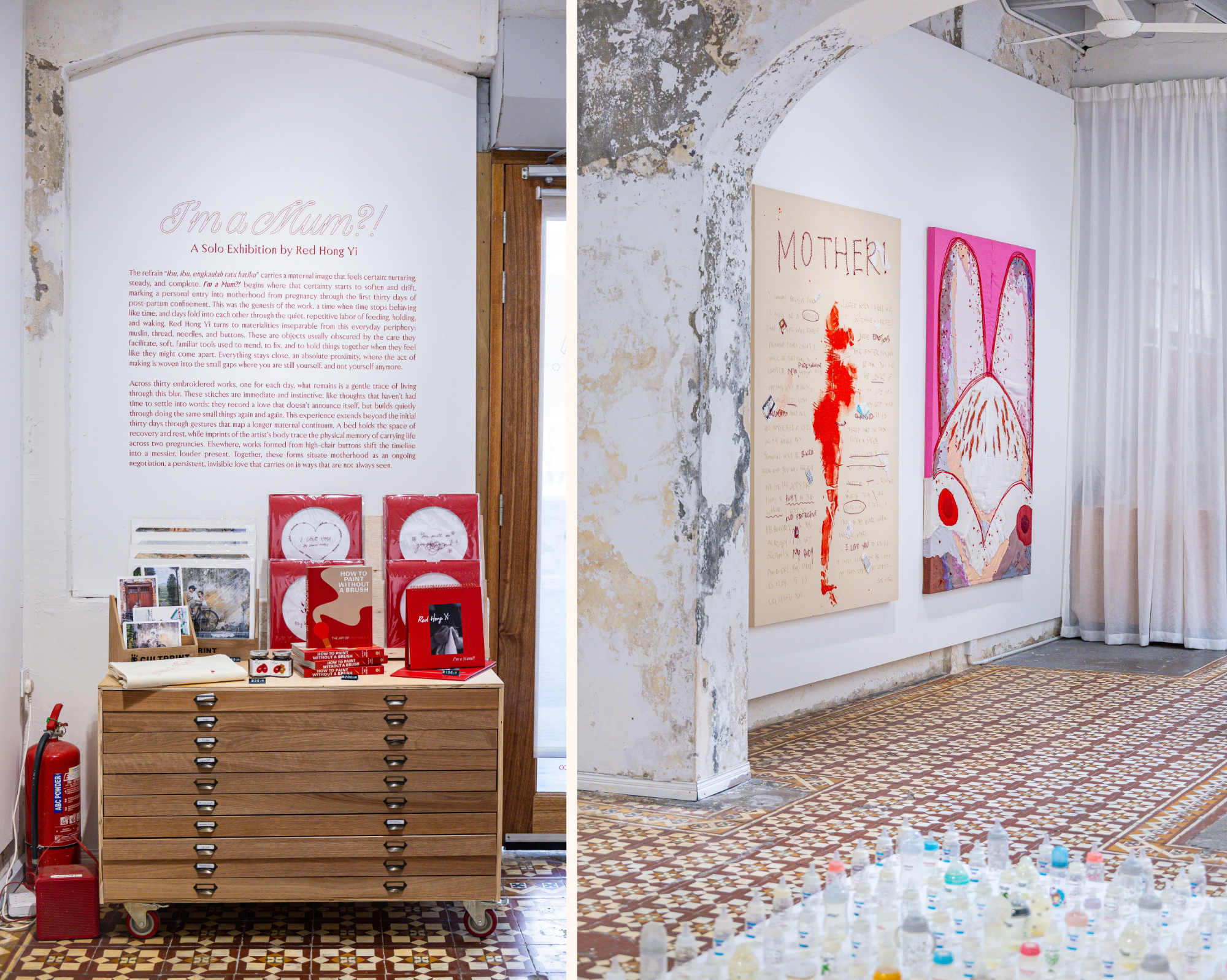
Red Hong Yi: Yes, very much. I didn’t know how to sew properly before having children. But as I was about to become a mother, and thinking about the body of work I wanted to create, I found myself instinctively drawn to textiles, buttons, fabric, and embroidery.
There was something about stitching that suddenly felt deeply emotional to me - the act of mending, repairing, piecing things back together slowly by hand. I imagined my child one day coming home with a missing button or torn pants saying, “Mama, can you fix this?” My old self would probably have reached for tape or glue! But something in me suddenly wanted to learn how to use thread.
I also think the materials I use will evolve as my kids grow older… let’s see!
What aspects of motherhood have been the most inspiring creatively? Are there particular emotions or moments that have found their way directly into your art?
Red Hong Yi: One of the most inspiring things for me has been seeing the world again through my children’s eyes - especially the curiosity they have towards things adults find completely ordinary.
I love baking with my toddler, for example. To us, flour or whipped cream are such familiar things, but to him they’re magical. He loves feeling flour between his fingers, tasting ingredients, playing with the spatula, or watching liquid cream suddenly turn fluffy with the sound and motion of a machine. There’s such pure wonder and joy in those moments.
That childlike curiosity inspires me deeply because it reminds me why I was drawn to using everyday objects in my art in the first place. I’ve always loved challenging the idea of what is considered mundane or insignificant. A chopstick, button, sock, tea bag, or piece of fabric can become something emotional or surprising when you look at it differently.
“Before having children, I think I subconsciously absorbed a very polished image of motherhood - something soft-focused, graceful, and instinctive. But when I became a mother myself, I realised how emotionally complex and disorienting it can be too. What really helped me through those early months were honest stories from other mothers. Not perfect stories - real ones.”
On the flip side, motherhood can also bring exhaustion, self-doubt, and overwhelm. How do you navigate those feelings while trying to stay creatively engaged?
Red Hong Yi: Oh, I’m constantly learning. I was so hard on myself in the early months following the birth of my first child and as I look back now, I wonder why I felt that way. I suppose it was the hormones, lack of sleep, and the shock of suddenly being responsible for another human being.
I tell myself now that I do not have to be as productive as before, and that this season of life is different. I’m learning to trust my team more and allow myself to slow down without feeling guilty about it. Some days, “success” simply means keeping two little humans alive, fed, loved, and making it through the day!
Ironically, motherhood has also made me more focused creatively. I have less time now, so I’m more intentional with it. I’ve learned that creativity doesn’t always need huge uninterrupted stretches of time. Sometimes ideas come while breastfeeding, or watching my toddler play, or during tiny quiet moments in between chaos.
I also remind myself that being an artist and being a mother are not competing identities. They inform one another. The emotional depth motherhood has brought me has changed my work profoundly.
After a long day of balancing motherhood and your creative practice, what helps you reset or reconnect with yourself?
Red Hong Yi: I find that exercising ALWAYS helps, even if it’s just a short walk in the park. Oh, and a good, warm shower!
What’s something you’ve learned about yourself since becoming a mother?
Red Hong Yi: That I genuinely love being a mum - more than I ever expected to. And I’ve only recently realised how much we are shaped by early life experiences, and that children don’t need a flawless parent - they need love, presence, repair, and emotional safety. I’m still learning that every day.
ON HER CAREER AS AN ARTIST
When you look back, what feels like the true “starting point” of your career, the moment you decided to take art seriously?
Red Hong Yi: I studied architecture in university, and my first job was as an architecture graduate in a firm in Shanghai in 2011.
Shanghai at that time was incredibly exciting - it felt like a huge mixing pot of careers, ideas, and experimentation, and everything was changing so quickly. There was a real sense that people were constantly trying new things, and that energy made me want to experiment too.
That environment really shaped how I began making work. I started creating art using everyday objects, often in large quantities, partly because I suddenly had access to materials in bulk, and partly because I was drawn to the visual and conceptual impact of repetition.
Over time, I began receiving commissioned projects that paid more than my salary. That was the moment I realised this could potentially become a livelihood if I chose to take it seriously and dedicate myself fully to it.
“At the same time, motherhood has made me more fearless because my perspective on what truly matters has shifted. I worry less about appearing perfect and more about creating work that feels sincere and human. Having children also makes time feel more precious. It pushes me to create the work I genuinely care about instead of overthinking how it will be received.”
What’s been a turning point project for you, the work that changed how the world saw you, or how you saw yourself?
Red Hong Yi: Possibly the artwork for the cover of TIME magazine - a world map made from 20,000 burning green-tipped matchsticks.
To be recognised by a publication like TIME and to have my work on its cover was surreal and such an honour. It felt like a moment where my practice moved onto a much larger global stage, and it also gave me a quiet sense of validation that this very unconventional way of working with everyday materials could resonate far beyond my own context.
It was definitely a pinch-me moment - both professionally and personally.

Are there specific experiences from your own motherhood journey that have directly inspired new work?
Red Hong Yi: There isn’t one single defining moment, because my thoughts on motherhood are constantly evolving as my children grow.
What motherhood has really given me is a constant sense of balancing - and learning to give myself grace for not being able to do everything perfectly. I’ve always been quite driven and used to want to do everything well, all the time. But motherhood has forced me to loosen that grip.
I want to be very present and involved in my children’s lives, and at the same time I deeply love my work as an artist. So right now, I’m still learning how to hold both worlds together without seeing them as separate or competing identities.
I’ve been very inspired by artists like Ruth Asawa, who deeply integrated her children into her practice and saw motherhood and art-making as interconnected rather than separate. She worked from a home studio so her children could be near her and understand her process - and I imagine that closeness must have also shaped her work in subtle ways.
That idea really resonates with me. I’m excited to keep exploring what it means to integrate my children into my creative life, and to see where that softer, more fluid way of working might lead.
How have you visually represented the emotional spectrum of motherhood, from tenderness to exhaustion to joy?
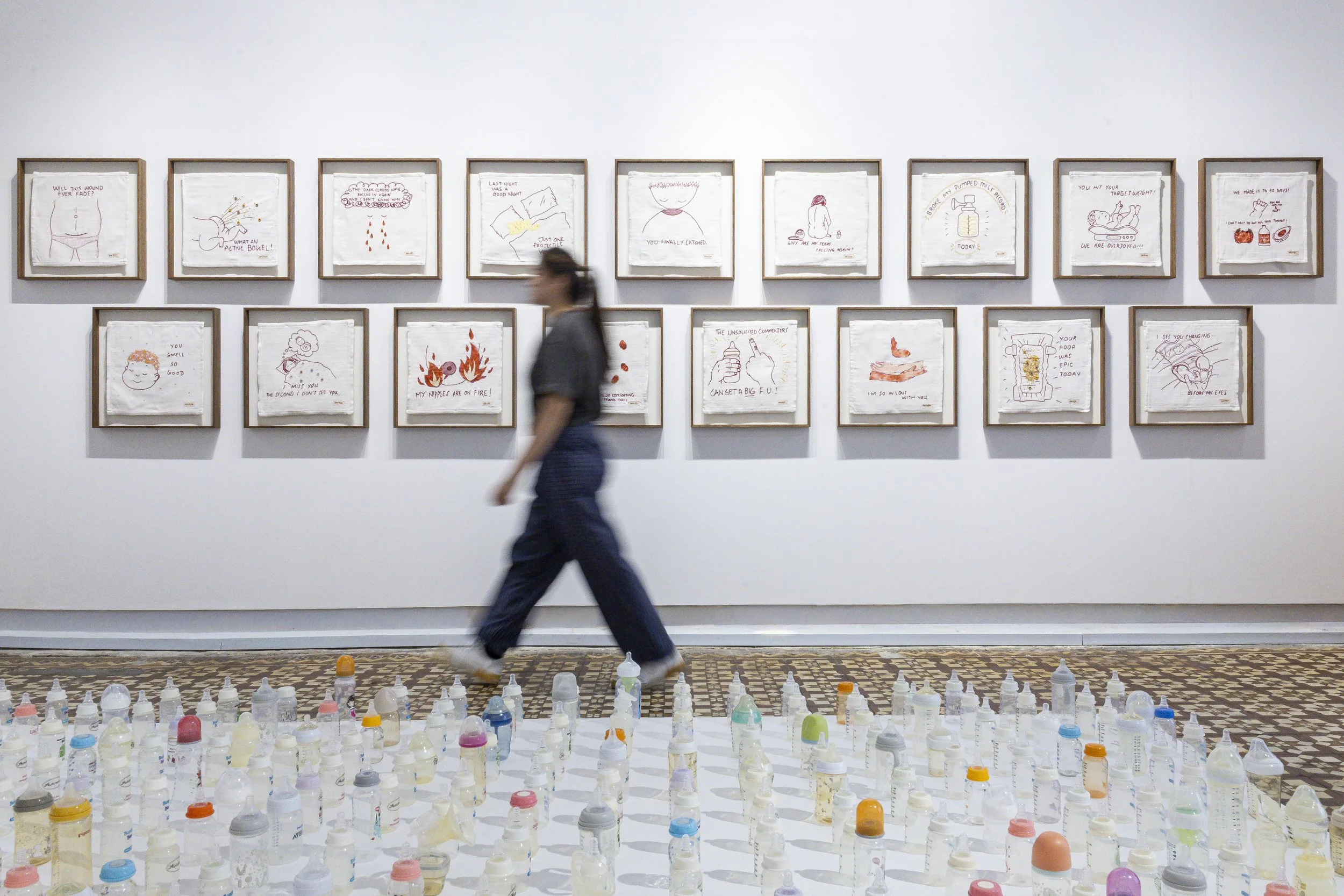
Red Hong Yi: I recently completed a series of 30 embroidered works based on my experience of the first 30 days postpartum - from day one to day thirty (they’re all included in the deck I’ve shared).
In the first month after my first child was born, I kept a sketchbook close by. Each day, I wrote a few words and made a quick drawing, trying to capture what I felt before it slipped away. I told myself I would embroider each of those sketches within those same thirty days.
That didn’t quite happen - in fact, it took me over two years to return to the work, and I only completed it properly after the birth of my second child, with the support of my studio team.
In a way, that delay also became part of the work itself. The pieces hold the highs and lows, joy and pain, clarity and confusion of early motherhood - and I wanted them to be as honest as possible, so that other mothers might see themselves reflected in them too.

Photographer Credit: Annice Lyn
Does your creative process look different now? For example, working around nap times or finding inspiration in quieter, more domestic moments?
Red Hong Yi: Yes, very much so - but I’m also very grateful that I have support systems in place.
I’m based in Malaysia, where nannies are relatively accessible, which helps a lot in allowing me to continue working. My toddler also goes to playschool in the mornings now, which gives me a few uninterrupted hours to focus and think more clearly.
I currently run a studio with 3 full-time employees – so being a business owner definitely helps with flexibility on my schedule, although it demands more of me as the business depends on me! I work from home often, and since I become a mother, I got the team to work from home on Wednesdays too.
“Before becoming a mother, I sometimes felt pressure to appear more composed or certain. Now I’m more comfortable sitting in complexity and contradiction.”
Was there a specific project that first made you think, “Okay… this could actually be my life’s work”?
Red Hong Yi: After I started posting my artwork online in 2012, I began receiving inquiries and commissions from people around the world. It felt surreal at the time because I was still working full-time in architecture in Shanghai.
One particularly unforgettable moment was when actor Jackie Chan saw my work in a magazine and invited me to meet him. I later created a portrait of him made entirely from chopsticks, inspired by the spirit and movement of his films. I remember thinking: “Wait… this strange thing I’ve been experimenting with in my spare time can actually connect with people.” I think it’s the familiarity of using everyday items that connects.
That project gave me confidence that art didn’t have to fit into a conventional mould to matter. It made me realise that my curiosity with materials and storytelling could become something sustainable and meaningful.
You became known for creating portraits with unexpected materials. How did that signature approach begin, and what problem were you trying to solve creatively?
Red Hong Yi: I’ve always been fascinated by ordinary objects and the invisible stories attached to them. I think part of it came from studying architecture, where materiality and scale matter so much. But I also found myself questioning traditional ideas of what art should look like, or what materials were considered “worthy” of art.
At the beginning, I was simply experimenting out of curiosity. I liked the challenge of taking something mundane - chopsticks, socks, tea bags, sunflower seeds, matchsticks - and transforming it into something emotional or surprising. There was something poetic to me about many small, everyday objects coming together to form a larger image.
I also think I was trying to make art feel more accessible. Sometimes contemporary art can feel intimidating or distant, but everyday objects are familiar. They belong to all of us. I loved the idea that someone could walk up to an artwork and suddenly recognise the materials and feel an immediate connection or sense of wonder.
What do you feel is most misunderstood about your work (or about you as an artist)?
Red Hong Yi: A lot of my process is actually very slow and repetitive. There’s a meditative quality to placing thousands of objects by hand, stitching embroidery for hours, or burning individual matchsticks one by one. The physical process matters to me just as much as the final image.
I also think people sometimes underestimate how emotional my work is especially because I use social media to connect with my followers. When I first started posting online, I remember how many galleries and artists shunned social media. Now everyone has an account online.
And that underneath the large-scale visuals and material experimentation are usually questions about identity, displacement, home, motherhood, culture, or human connection.
Do you think motherhood has made you more fearless or more reflective as an artist?
Red Hong Yi: Both. Motherhood has made me more emotionally vulnerable, which I think has made me more honest in my work. Before becoming a mother, I sometimes felt pressure to appear more composed or certain. Now I’m more comfortable sitting in complexity and contradiction.
At the same time, motherhood has made me more fearless because my perspective on what truly matters has shifted. I worry less about appearing perfect and more about creating work that feels sincere and human.
Having children also makes time feel more precious. It pushes me to create the work I genuinely care about instead of overthinking how it will be received.

Photographer Credit: Annice Lyn
How do you define success for yourself today? And what has been one of the biggest highlights of your career so far? Any pinch me moments?
Red Hong Yi: My definition of success has changed a lot over the years. Earlier in my career, success felt tied to visibility, recognition, and big opportunities. Those things are still meaningful, of course, and I’m incredibly grateful for them.
But today, success feels more holistic to me. It’s being able to make meaningful work while also being present for my children and loved ones. It’s having enough freedom to create sincerely and sustainably. It’s seeing my children grow in a happy and healthy environment, and for them to feel loved.
Some pinch-me moments include creating the cover artwork for TIME magazine, exhibiting internationally, and seeing people emotionally connect with my work in ways I never expected. But honestly, this upcoming exhibition on motherhood feels deeply special to me too, because it feels like one of the most personal things I’ve ever made.
ON IDENTIFY & LOOKING AHEAD
Has becoming a mother changed your sense of self-expression, the way you dress, create, or move through the world?
Red Hong Yi: Definitely. Practicality suddenly became very important! I used to wear a lot more structured or delicate clothing, and now I find myself thinking things like: “Can I breastfeed in this?” or “Can I run after a toddler in these shoes?”
But emotionally, motherhood has also softened and grounded me in unexpected ways. I think I move through the world with more empathy now. I notice mothers everywhere - exhausted mothers, patient mothers, overwhelmed mothers - in a way I didn’t before. I even think about what mothers would want to eat or drink – and I am concocting something in my kitchen right now that I’m hoping will work out as a retailed consumer product! Stay tuned!
“But emotionally, motherhood has also softened and grounded me in unexpected ways. I think I move through the world with more empathy now. I notice mothers everywhere - exhausted mothers, patient mothers, overwhelmed mothers - in a way I didn’t before.”
How do you balance being present for your child while also staying true to your artistic ambitions?
Red Hong Yi:I honestly don’t think balance is a fixed thing. Some days motherhood takes more from me, and other days work does. I’m still figuring it out in real time.
What helps is trying not to see the two worlds as enemies. I used to think I had to separate “artist me” and “mother me,” but increasingly I realise they deeply feed each other. My children have made me more observant, more emotional, more patient, more playful - all things that influence my art.
I also try to include my children in parts of my process where possible! I remember loving visiting my parents’ offices – even my mum’s – and she worked in a bank!
Photographer Credit: Annice Lyn
What’s next for you? What are you excited about in the next few months?
Red Hong Yi: Right now, I’m very focused on my upcoming exhibition, “I’m a Mum?!”, launching at Cultprint in George Town over Mother’s Day weekend. It’s one of the most personal bodies of work I’ve ever created, and I’m excited (and honestly a little nervous!) to finally share it with people.
I’m also experimenting with projects outside the traditional art space. Recently, I created a small-batch red date paste product called Date With Red, inspired by nourishing foods often associated with postpartum care and motherhood in Asian culture. I made 200 bottles as part of my exhibition as a kind of creative market test, which has been really fun and interesting for me. I love the idea that creativity can move between art, storytelling, food, objects, and everyday rituals of care.
What’s the legacy you hope to create as an artist and as a mother?
Red Hong Yi: As an artist, I hope my work makes people pause and see the world differently, even briefly. I hope it reminds people that ordinary things can hold beauty, meaning, and emotional weight.
As a mother, I hope my children grow up feeling deeply loved, emotionally safe, curious about the world, and free to become fully themselves.
I think ultimately both art-making and motherhood come from the same desire: to leave behind something filled with care, humanity, and connection.
And finally, what message would you like to leave with the Luminary Mothers community?
Red Hong Yi: I think motherhood can feel incredibly lonely sometimes, even though it is such a universal experience. So I suppose I’d simply want mothers to know that they are not alone in the complexity of it all - the joy, grief, exhaustion, identity shifts, tenderness, guilt, love, overwhelm.
There is no perfect mother. We are all learning as we go.
And I hope mothers continue making space for themselves too - for their creativity, ambitions, friendships, rest, and individuality. Becoming a mother does not erase who you are. If anything, it reveals even more parts of you.
Follow red Hong Yi on Instagram here.