
Tess Robinson on Building Land Lab and a New Prenatal Standard.

Images Source: Land Lab
The prenatal category is crowded, and yet, truly rigorous formulations are still surprisingly difficult to find. Many products lean on long ingredient lists and polished marketing, while quietly falling short on what matters most: clinically adequate dosing, bioavailable forms, and thoughtful design that accounts for the realities of pregnancy and postpartum. In a season where nutrient needs rise sharply and the “margin for error” feels lower than ever, that gap matters.
Land Lab was created to close it. Co-founded by Tess Robinson, the brand approaches maternal supplementation like a science product: built through practitioner-led peer review, formulated for measurable outcomes, and designed with the lived reality of mothers in mind. When Tess and her team looked closely at the market, what they saw wasn’t just noise, it was inconsistency. Foundational nutrients like choline were frequently under-dosed, and key ingredients were often delivered in cheaper, less bioavailable forms. A concern in a life stage that is biologically demanding, metabolically intense, and anything but “one-size-fits-all.”
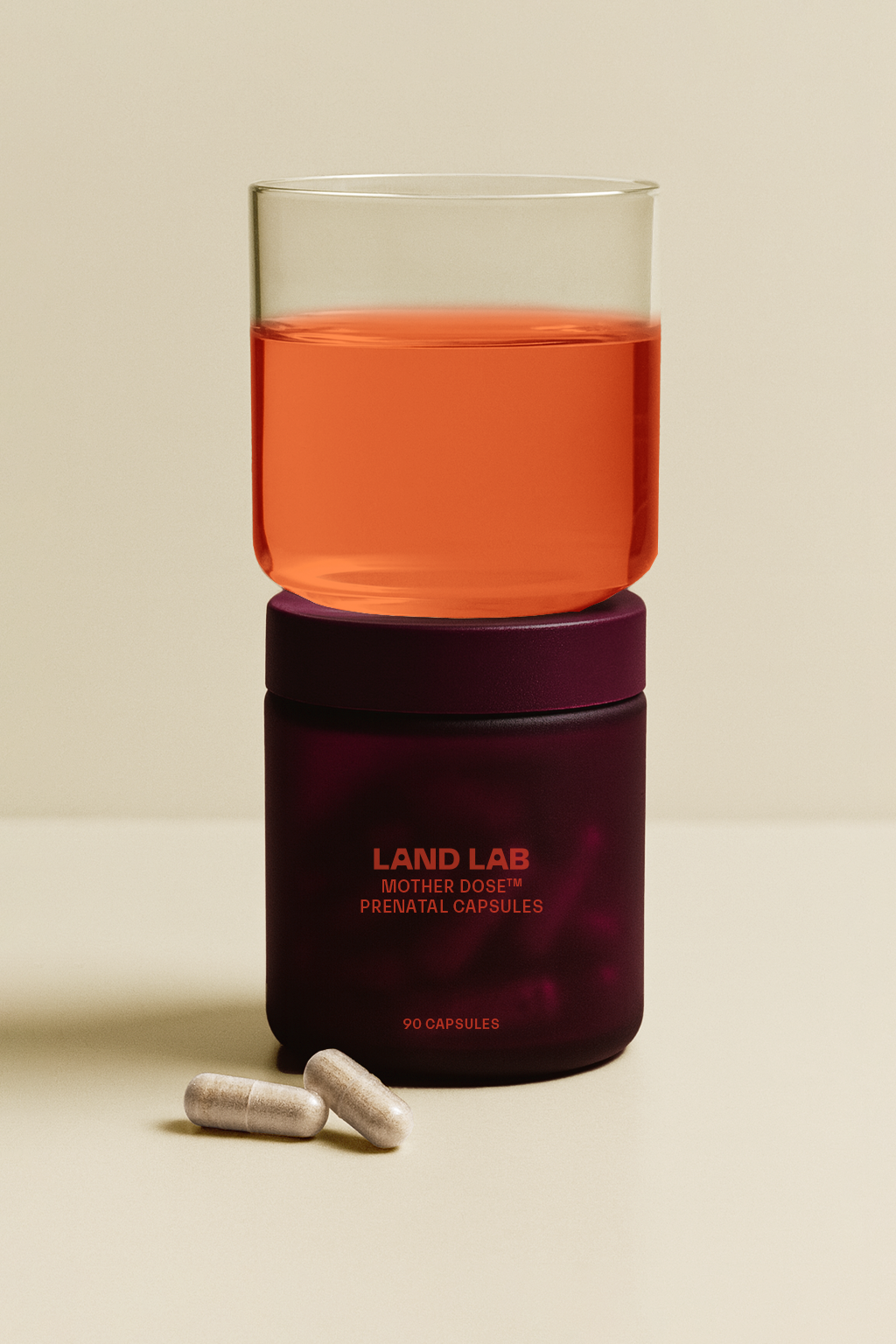
Their hero product, Mother Dose, is positioned as a prenatal for the full continuum: planning, pregnancy, and postpartum, with a strong point of view: more isn’t always better, and a longer label doesn’t always translate to deeper clinical impact. Instead, Land Lab focuses on therapeutic dosing and ingredient forms that hold up to scrutiny, while leaving room for individualisation depending on a woman’s needs, including the belief that iron should be optional rather than blanket-dosed unless clinically indicated. The product experience is equally intentional. Knowing nausea is one of the most common barriers to supplement compliance, Mother Dose is designed so the capsules can be opened and mixed into food or drink, a small detail that can make an enormous difference for women navigating morning sickness. Even the sensory details are considered: a gentler smell, a subtle, zesty taste, and an experience that feels elevated rather than medicinal.
But Land Lab is building something bigger than a single product, and they’re doing it with a distinctly Australian lens. From the beginning, the brand has been focused on the clinical potential of Australian native botanicals, approached with scientific rigour and ethical responsibility. In Mother Dose, that story begins with Kakadu Plum. Selected for its nutritional power, but treated as far more than a “superfood.” As Tess puts it, native ingredients carry biocultural significance and require benefit-sharing and Indigenous-led supply chains, an approach that prioritises long-term stewardship over extractive sourcing.
Just as important is what Land Lab is trying to shift structurally: access. Through Motherlines Foundation, the brand’s philanthropic arm, Land Lab provides ten months of free prenatal nutrition to women who hold an Australian healthcare concession card, because raising formulation standards is meaningless if women can’t reach them. Ultimately, the ambition is twofold: to make evidence-based, practitioner-shaped supplementation the norm rather than the exception, and to help change how we support mothers beyond pregnancy, including the often-overlooked reality of postpartum depletion.
Below, Tess shares the thinking behind Land Lab, the philosophy that shaped Mother Dose, and why she believes motherhood and ambition can coexist, and even strengthen one another.
By Alice Codford, in partnership with Land Lab

Images Source: Land Lab
Alice: What was the gap you saw in the prenatal space that felt most urgent to fix?
Tess Robinson: What stood out immediately to the team and I, was the quality of formulation. We kept seeing clinically inadequate dosages across foundational nutrients like choline, and when ingredients were included, they were often in cheaper, poorly absorbed forms, like folic acid instead of methylfolate. This felt particularly concerning given pregnancy is a window where nutrient needs are at their highest and the margin for error is at its lowest.
But beyond the clinical gaps, there was also a structural one: access. Through Motherlines, our philanthropic arm, we’re working to distribute free prenatal nutrition to women who need it most, because raising formulation standards is meaningless if women can’t access them.
And thirdly, the more we looked, the more we felt the prenatal market had become extremely standard and transactional, with very little intentionality for such a meaningful and biologically demanding life stage. Nothing spoke to the modern mother; intellectually, emotionally, or aesthetically.
Tell us how Land Lab started?
Tess Robinson: My business partner and I had been concepting Land Lab for years before we launched. It’s been a true labour of love; driven by equal parts ambition, reverence and hard work.
We brought together a network of doctors, dietitians, naturopaths, biochemists, researchers and midwives to begin peer-reviewing our prenatal formulation; interrogating dosages, ingredient forms and clinical validity. What became clear quite quickly was that our review process was more rigorous than what most supplement companies were doing internally.
From there, Land Lab was born as a science-first supplement company; with our prenatal as the entry point, but never the end point. From the beginning, we’ve been deeply focused on the clinical potential of Australian native plants: building what is now the world’s first evidence-based supplement pipeline dedicated to Australian native plants, grounded in both nature’s intelligence and modern research.
Was there a specific moment in pregnancy or postpartum that made you think: “I want to build a product for women in the same season?
Tess Robinson: My children were three and six when we began developing the idea, so I always joke that I was in late postpartum when Land Lab was conceived. I was very aware, both nutritionally and energetically, of the depletion that can linger well beyond the newborn phase.
Having two children of my own, I also feel, daily, how high the stakes are with what we’re doing. Every decision we make, and every input into the formulation, feels consequential; because I know firsthand what it means to be responsible for growing and sustaining life.
For both myself and my business partner, there is a strong desire to build something that makes women feel held, and to showcase the grit and strength of mothers.
And beyond that, I would have loved this formula had it existed during my own pregnancies. I was incredibly nauseous both times, and our capsule design - which allows you to open and integrate the formula into food or drink - would have made a big difference to my experience.
What were you looking for in a prenatal vitamin that you couldn't find, and did that spark a few initial ideas for Mother Dose?
Tess Robinson: To be honest, the desire to create a supplement company built from the clinical potential of Australian native plants came first. Prenatal was the entry point, but the broader vision was always much bigger.
In saying that, the way we carved out white space in the prenatal market was through formulation. We were looking for therapeutic dosages; which were almost impossible to find. We wanted iron to be optional rather than blanket-dosed, unless clinically indicated. And of course, bioavailable mineral forms were non-negotiable.
We included Kakadu plum as a native, wholefood source of vitamin C to support immune function and nutrient absorption, alongside a clinical dose of ginger to help ease nausea. We also designed the capsules to be opened and integrated into food or drink; a small but meaningful detail for women navigating morning sickness.
And critically, we wanted the formula to be peer-reviewed; shaped by practitioners, not just product formulators. That collaborative review process ultimately became the blueprint for Mother Dose.
Images Source: Land Lab
What’s one ingredient decision that took the longest to land on, and why?
Tess Robinson: Without question, Kakadu Plum. Not because we weren’t convinced of its nutritional profile, that part was obvious. Kakadu Plum contains the highest natural concentration of vitamin C in the plant kingdom and is exceptionally rich in polyphenols and other antioxidant compounds. From a biochemical perspective, it’s extraordinary. What took time was everything around it.
Native Australian plants are under-utilised not because they lack value, but because they are biologically intense. These plants evolved in some of the harshest environments on earth - exposed to drought, wildfire, nutrient-poor soils and extreme UV. Their insane bioactive density is an adaptation to survive those conditions. But that same density often means thick skins, high tannin levels, tartness, seeds, fibrous textures… they’re not soft, sweet supermarket fruit. So, the first challenge was formulation: how do you incorporate a plant this potent into a prenatal in a way that is bioavailable, palatable, stable and genuinely usable? Particularly in early pregnancy, when nausea is common and tolerance is low.
But the bigger question was ethical. Kakadu Plum is not just a “superfood.” It is a culturally significant native ingredient with biocultural intellectual property held by First Nations communities. Historically, Australia’s native plant industry has been extractive, with less than 2% of industry value returning to First Nations people. We were not willing to participate in that model. So, landing on Kakadu Plum meant building the right partnerships first. Working through Indigenous-led supply chains. Ensuring benefit-sharing. Prioritising long-term relationships over opportunistic sourcing. Accepting that ethical sourcing can be slower, more complex and more expensive, and choosing it anyway. So, I guess it took the longest because it had to be done properly.
How do you balance the desire to “cover everything” with the reality that more isn’t always better?
Tess Robinson: For us, it always comes back to formulating for measurable outcomes, not label appeal. There’s a temptation in supplements to create long ingredient lists because they look comprehensive, but that doesn’t always translate to clinical impact.
We prioritise nutrients with the strongest maternal outcome data and avoid redundancy or nutrient competition that can compromise absorption. More isn’t always better, sometimes it’s just noise.
We also view a prenatal as a foundation, not an entire protocol. Its role is to deliver the most critical, evidence-backed support, while leaving space for individualisation depending on a woman’s needs.
What do you think people get wrong about prenatals or about supplements in general?
Tess Robinson: I think one of the biggest misconceptions is that if you have a good diet, you don’t need a prenatal. Nutrition is foundational, of course, but pregnancy significantly increases nutrient demands, and it’s incredibly difficult to meet those requirements through food alone.
There’s also an assumption that all prenatals are created equal, which simply isn’t the case. Ingredient quality, dosage sufficiency and bioavailability vary enormously between formulas.
People often equate longer ingredient lists with better products, but more doesn’t always mean more effective. And finally, I think many consumers are still placing more trust in marketing than in practitioner insight or clinical formulation standards, which is something we’re working hard to shift.
You’ve spoken about raising health equity standards. What does that mean beyond the words? Where do you want Land Lab to have real impact?
Tess Robinson: For us, health equity starts with access. In Australia, a staggering 25% of women can’t afford a prenatal. Through our charity, Motherlines Foundation, we provide ten months of free prenatal nutrition to women who hold an Australian healthcare concession card, supporting those who are financially disadvantaged through pregnancy and postpartum.
Because raising formulation standards is important, but it only matters if all women can actually access those standards.
Beyond that, we’re committed to lifting the bar industry-wide. We want peer review, therapeutic dosing and evidence-based formulation to become expected, not exceptional.
Longer term, the goal is much bigger than supplements. It’s about shifting baseline maternal health outcomes, ensuring more women enter pregnancy, move through it, and recover from it with deeper nutritional support.
Images Source: Land Lab
What has motherhood asked of you that business never did?
Tess Robinson: Motherhood has asked for a level of surrender that business never did. In business, you can plan, optimise and (mostly) control outcomes, but motherhood destroys that illusion very quickly.
It’s required a deeper commitment to nervous system regulation; learning how to stay grounded, present and resourced, even in seasons that feel chaotic and demanding.
It’s also expanded my emotional capacity in a way I didn’t expect; the ability to live in the future (for business and planning) and in the present moment (with my kids) simultaneously.
At the same time, it’s sharpened my ability to prioritise and execute. You become incredibly efficient when time is finite.
And ultimately, it’s redefined my metrics for success; shifting from growth at all costs to impact, presence and sustainability.
When you think about the mother you’re becoming, what do you hope your children learn from watching you build this?
Tess Robinson: I hope they see that women can build systems that empower them, and in doing so, redefine the ones that obstruct them.
I want them to witness devotion to meaningful work - the kind that’s driven by purpose. I feel genuinely lit up by what I do, and I hope they see how that light spills into every facet of my life.
And I hope they understand that creativity isn’t indulgent. For me it’s a lifeline. And it’s how they can one day imagine better futures and build them into reality.
I also want them to see the courage it takes to challenge outdated industries, and the integrity required to do so responsibly.
And perhaps most importantly, I hope they grow up knowing that motherhood and ambition don’t have to compete. They can coexist, and even (and perhaps most importantly) strengthen one another.
What do you want Land Lab to change for mothers in five years?
Tess Robinson: At an industry level, I’d love to see formulation standards lifted across the board, with therapeutic dosing, bioavailable forms and peer review becoming the norm rather than the exception.
But more personally, I want postpartum nutrition and depletion to be taken far more seriously.
There’s so much focus on supporting women through pregnancy, and then a sharp drop-off the moment the baby arrives. Yet nutritionally, that recovery window is one of the most demanding seasons a woman will ever move through.
If Land Lab can help shift that conversation, from pregnancy-only care to full-spectrum maternal recovery, that would feel like meaningful progress.
A lesson motherhood keeps teaching you?
Tess Robinson: That control is an illusion! haha.
I feel like motherhood constantly reshapes my priorities and perspective. It makes you rethink what you consider to be the “important” things in life - whether it be goals or definitions of success. I find myself continually reprioritising my time, my goals and my energy to better align with what I want to give my children, not just materially, but emotionally and energetically too.

Images Source: Land Lab
What’s a motherhood reality you wanted Mother Dose to acknowledge (nausea, fatigue, mental load, postpartum depletion)?
Tess Robinson: That pregnancy isn’t soft, it’s seismic. There’s a cultural tendency to romanticise it as this gentle, glowing season; all belly rubs and barefoot walks on the sand. And while there can be beauty in it, the biological reality is far more intense.
Mothers are strong; physically, mentally, hormonally. The body undergoes one of the most metabolically demanding processes it will ever experience. Creating a baby requires extraordinary energy output and birth itself demands a level of strength and resilience that’s hard to quantify until you’ve lived it.
We wanted Mother Dose to honour that grit. To recognise that what women are doing isn’t delicate; it’s powerful, wild, and deeply physiological. And the nutritional support should rise to meet that reality.
When you were designing the product experience, what “small” detail mattered more than people might think?
Tess Robinson: So much of our thinking centred around nausea, because morning sickness is one of the most common barriers to supplement compliance in pregnancy.
We designed the capsules to be opened and stirred into food or drinks, which sounds like a small detail but can make an enormous difference for women who simply can’t stomach swallowing tablets.
We also paid close attention to the sensory experience; ensuring the formula had a gentle smell and a subtle, zesty taste rather than anything medicinal or overpowering.
And then there were the physical details; the tactility of the jar, the unboxing experience. I’m from brand, so the aesthetics and experience in this realm was something I spent many, many nights pouring over.
What did you personally need more of in pregnancy/postpartum: support, clarity, simplicity, or permission?
Tess Robinson: Clarity first, without question. There’s so much noise in the pregnancy space, and so much conflicting advice, that I really craved clear, evidence-backed guidance I could trust.
And postpartum depletion was very real. That season requires far more acknowledgement and nutritional support than it often receives, which is something that deeply shaped how we approached Mother Dose.
How do you approach native ingredients with respect, responsibility, and real rigour?
Tess Robinson: For us, working responsibly with native ingredients isn’t a marketing angle, it’s a core obligation.
We work solely with Indigenous growers and suppliers, ensuring our sourcing relationships honour both cultural knowledge and custodianship of the land. That includes ethical sourcing agreements and formal benefit-sharing models, so that the communities who have stewarded these plants for generations participate meaningfully in the value being created.
Scientific rigour is equally important. We’re committed to validating native ingredients through clinical research, ensuring that nature’s intelligence and modern evidence sit side by side, not in competition, but in collaboration.

Images Source: Land Lab
What does it mean to build something “from this land” while being mindful about stewardship and supply chains?
Tess Robinson: To build from this land means first acknowledging its ecological and cultural origins, and recognising that native plants aren’t simply ingredients, they’re part of living systems.
For us, stewardship shows up through transparent sourcing, investing back into communities, and building regenerative supply chains that protect the longevity of these plants rather than extracting from them.
It also extends into research. We’re deeply committed to Australian clinical partnerships, ensuring the science validating these ingredients is being developed here, contributing to both national innovation and global credibility.
What excites you about Australian native botanicals that the wider world hasn’t caught up to yet?
Tess Robinson: The potency, first and foremost. Many Australian natives have extraordinary nutrient density. Kakadu Plum, for example, is the richest natural sources of vitamin C in the plant kingdom.
These plants have adapted to some of the harshest growing conditions on earth - extreme UV exposure, drought and poor soils - which has driven the development of powerful phytonutrients, antioxidants and anti-inflammatory compounds.
What excites us most is how underexplored they still are in modern health. There’s enormous untapped potential there.
And globally, I think Australia has an opportunity to set a new standard, not just in ethical native ingredient storytelling, but in evidence-based application that sets a new benchmark for the category.
