Women Having Babies After 40: What Does Age Mean in Motherhood Now?

What is a “geriatric pregnancy” nowadays? Motherhood is no longer confined to one narrow chapter of a woman’s life. More women are having babies after 40, first babies, third babies, even sixth babies, and with that shift comes a bigger cultural question: what does age mean in motherhood now?

Women Having Babies After 40 Anne hathaway sienna miller luminary mothers alice codford thought piece What Does Age Mean in Motherhood Now

Pregnancy after 40 has long been treated as an exception. Often categorised as a “late” arrival or a modern medical miracle. A biological footnote to the more culturally approved story of motherhood, which is still too often imagined as something that should happen within a specific time window. The language makes the assumption plain: advanced maternal age, high risk, geriatric pregnancy. Beneath it all sits the same old premise that motherhood has an ideal timeline, and that women who move outside it are somehow defying not only biology, but common sense.

But perhaps the more interesting question now is not whether the term is offensive. It is what the term reveals about how dramatically the meaning of age is changing.

“Geriatric pregnancy” may be the phrase that catches our attention, but it is not really the story. The story is that age itself is being culturally renegotiated. Forty no longer means what it once did. Motherhood no longer belongs to one narrow chapter of a woman’s life. And increasingly, women are having babies at ages that once sat outside the conventional maternal imagination.

More women are having babies later. And they are not doing it quietly, it’s not rare anymore, and not as some strange exception at the edge of fertility statistics, but publicly, confidently, and increasingly as part of the modern maternal landscape. Women are having first babies in their late thirties and forties. They are having second and third (even 6th!) babies after 40. They are growing families after careers have been built, relationships have changed, eggs have been frozen, treatments have been tried, partners have been found later, or life has simply unfolded in a different order than expected, or told it should be.

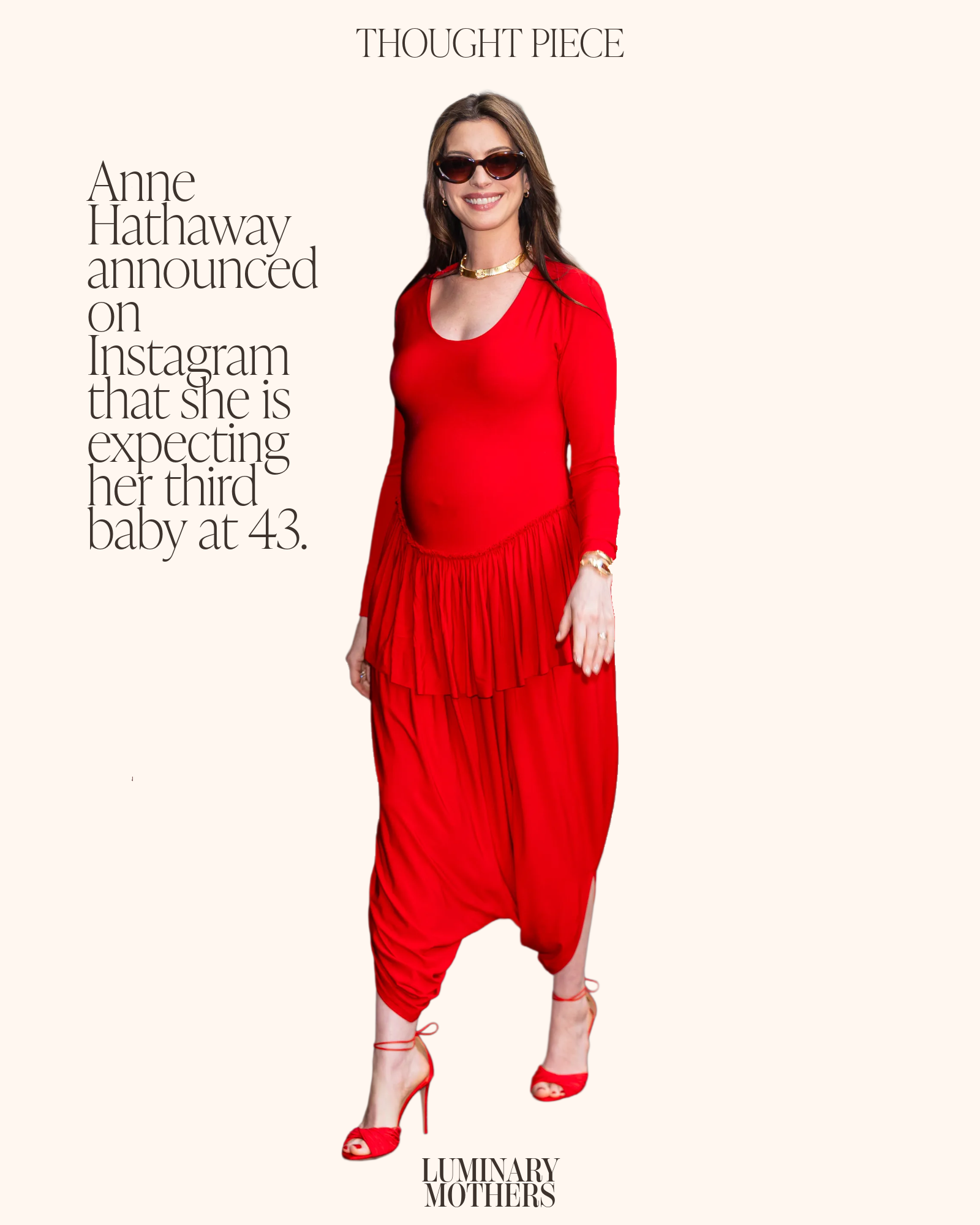
Anne Hathaway is expecting her third child at 43. Sienna Miller recently welcomed her third baby in her forties. Natalia Vodianova is reportedly expecting her sixth at 44. These stories attract attention because celebrity pregnancy always attracts attention, but also because they reflect a broader cultural shift. Later motherhood is no longer a private exception. It is becoming a public pattern.

And that raises the real question. What does age mean anymore?

By Alice Codford


There was a time when 40 carried a different cultural weight. It suggested a closing down, a settling and a narrowing of possibility. For women especially, it was often treated as the threshold between desirability and invisibility, fertility and decline, youth and whatever came after. Motherhood after 40 was seen as unusual because women after 40 were so often imagined as having moved beyond the stage of beginning.

That idea now feels increasingly out of step with the way women actually live. Forty plus is no longer a fixed marker of arrival or ending. It can be a new beginning, a reinvention, a return or an expansion. A woman at 40 may be entering her most professionally powerful decade. She may be more financially stable, more emotionally grounded, more selective in love, more certain of herself, more able to choose motherhood from desire rather than expectation. She may not be late at all. She may simply be arriving at motherhood at the point in life when it finally makes sense to her.

Anne Hathaway is reportedly expecting her third child at 43. Natalie Portman is pregnant with her third at 44. Natalia Vodianova is expecting her sixth at 44. Sienna Miller recently welcomed her third baby in her forties, while Gisele Bündchen, Kourtney Kardashian Barker, Hilary Swank, Cameron Diaz, and Naomi Campbell have all become part of a growing public story of women expanding their families well beyond the age once treated as the edge of possibility.

Women Having Babies After 40 Anne hathaway sienna miller luminary mothers alice codford thought piece What Does Age Mean in Motherhood Now alice codford

This does not mean age has become irrelevant. Biology has not disappeared because culture has changed. Fertility does decline with age, and of course, pregnancy after 40 can carry greater risks and often requires more careful medical attention. There is no liberation in pretending that the body is not real. But there is also no wisdom in treating biology as though it tells the whole story. The mistake has always been to confuse age with meaning.

A woman having a baby at post 40 is not simply an older mother. She may be a mother with more experience, more resources, more perspective, more autonomy. She may be parenting with a clarity she did not have at 30. She may be extending a family she already loves, or beginning one she spent years imagining. Her age may matter medically, but it does not define the emotional, social, or existential meaning of her motherhood.

This is where the culture has been slow to catch up. We have extended adolescence, delayed marriage, redefined career timelines, normalised second acts, and stretched the idea of adulthood into something far less linear than it once was. Women are expected to become educated, financially independent, emotionally self-aware, professionally established, and personally discerning. Yet when those same women have children later, the culture still behaves as though they have missed the correct moment. And there is a contradiction in that, because women are told to build lives before motherhood, but not take too long building them. They are encouraged to choose carefully, but reminded that choice has a deadline. They are told that age brings confidence, wisdom, and self-knowledge, until that age belongs to a pregnant woman. Then suddenly it becomes a risk factor before it is allowed to be anything else.

Perhaps that is why these celebrity pregnancies feel culturally resonant. They are not important because famous women should define motherhood for everyone else. They are important because visibility changes what feels possible. When women see other women having babies in their forties, not as cautionary tales but as ordinary, joyful, complicated human stories, the old narrative begins to loosen. The timeline starts to look less fixed, and the question shifts from “Isn’t she too old?” to “Why did we ever imagine there was only one right age?”

sienna miller Women Having Babies After 40 Anne hathaway sienna miller luminary mothers alice codford thought piece

This is not just a celebrity trend. It is part of a wider demographic movement. Women are having children later across much of the developed world, shaped by economics, education, relationships, fertility technology, longer life expectancy, and changing expectations of what adulthood should contain before motherhood begins. Some of this shift is chosen. Some of it is circumstantial. Much of it is both. But the result is clear: the age of motherhood is moving. And when motherhood moves, culture has to move with it.

For too long, women have been spoken about as though their reproductive lives should remain untouched by every other transformation in modern life. Careers changed. Relationships changed. Medicine changed. Family structures changed. The meaning of adulthood changed. But the maternal timeline was somehow expected to remain fixed, as if women were still living inside a world that offered them one narrow path and punished them for hesitating. And that world no longer exists, at least not in the same way. The modern mother may be 28 or 38 or 43. She may be partnered, single, remarried, assisted by IVF, using donor eggs, having her first child, or her fourth. She may have waited because she had no choice, or because she had many. She may feel young, old, ready, terrified, grateful, exhausted, or all of these things at once. What defines her motherhood is not only the number attached to her age, but the life that brought her there.

This is why the phrase “geriatric pregnancy” now sounds so strange. Not simply because it is unflattering, though it is. Not simply because it feels medically cold, though it does. But because it belongs to an older imagination of women’s lives. It assumes that age is a decline rather than a context. It assumes that later motherhood is primarily a problem, rather than one expression of how dramatically women’s choices, opportunities, and realities have changed.

There is also a particular kind of visibility to this moment. When a famous woman announces a pregnancy in her forties, the reaction often moves quickly between admiration, curiosity, scepticism, and disbelief. People want to know how, they want to know whether it was natural and they want to know whether it was planned. Beneath those questions is a fascination not only with fertility, but with age itself. A woman over 40 who is pregnant seems to unsettle the structured categories culture still wants to preserve: young and old, fertile and finished, beginning and ending. But life doesnt always follow the same structure as these categories suggest. The very idea of “later” depends on the timeline being used. Later than what? Later than our mothers? Later than medical textbooks? Later than the social expectations built around a world in which women had fewer choices, fewer reproductive technologies, fewer career opportunities, and far less control over the shape of their adult lives? If the conditions of womanhood have changed, then perhaps the meaning of timing has to change too, right?

natalie portman pregnant sienna miller Women Having Babies After 40 Anne hathaway sienna miller luminary mothers alice codford thought piece

This is not to turn later motherhood into a new ideal, or to pretend it is effortless, inevitable, or available to everyone. Fertility can be uneven, expensive, emotional, and unfair. Many women who want children later face uncertainty, loss, intervention, or disappointment. Celebrity examples do not reflect every woman’s reality. But they do reflect a story that has become larger than the old assumptions allow.

More women are having babies after 40, and that fact sits inside a broader reimagining of female adulthood. Age no longer operates as a simple measure of possibility. A woman may be medically categorised as advanced maternal age while feeling personally, emotionally, or creatively in one of the most expansive seasons of her life. She may be treated as a risk profile by one system, and as a woman in bloom by another.

So what is a geriatric pregnancy nowadays? Perhaps it is less a description of a woman’s age than a reminder of how old our assumptions have become, and that we are all on timelines that looks more and more like the modern world women are actually living in.

Luminary Mothers

Luminary Mothers is a Style & Culture World for Modern Mothers in all stages of Motherhood.

https://LuminaryMothers.com
Next
Next

What We Love This Week: 9th July 2026