
Trust Yourself, Not the Noise: Breastfeeding, Pumping & the Fourth Trimester with Lola&Lykke Founder Laura McGrath.

Images Courtesy of Lola&Lykke
The moment you become a mother, the noise begins.
It starts innocently enough — a well-meaning comment, an offhand “have you tried…?”, a late-night scroll that somehow leaves you feeling worse and more confused. And if feeding is part of your postpartum story — breastfeeding, pumping, combination feeding, stopping earlier than you planned — the noise gets louder.
Because feeding is never just feeding. It’s bodies and identity and guilt. It’s sleep deprivation and leaking and timing your life in two-hour blocks. It’s the invisible work of trying to do the “right” thing in a world that rarely agrees on what “right” even means.
In this collaboration with Lola&Lykke, we wanted to go beyond a product conversation and into the real centre of it: the woman. The one living inside the experience. The one being told, directly and indirectly, how to do motherhood “properly.”
That’s also why this partnership with Lola&Lykke feels so aligned: they build for the mother as a whole person — not just the “mum” part — combining function with beauty in a season where so many women feel like they disappear.
So we built this piece around one theme that keeps returning — in Laura McGrath’s story, in her philosophy, and in what so many mothers quietly have to relearn in the fourth trimester:
Trust yourself, not the noise.
By Alice Codford in Partnership with LOLA&LYKKE
MOTHERHOOD ISN’T “NATURAL”, IT’S A LEARNING CURVE.
Lola&Lykke was born from frustration — the personal kind. The kind that comes from living through motherhood and realising the system isn’t designed with mothers in mind.
Laura’s early experiences of new motherhood were coloured by complications, and then, heartbreakingly, the loss of her second baby later in pregnancy. That combination — physical and emotional — became a turning point. She describes a world where mothers are treated as a category rather than individuals, “lumped into the same group” regardless of what they’ve been through.
What’s striking is how her story isn’t about “bouncing back” or “finding the hacks.” It’s about taking control — the moment she approached her third pregnancy differently and began advocating for herself, while also recognising that not everyone has the resources, energy, or confidence to do that.
That gap — between what mothers are expected to carry and what they’re actually supported with — is where Lola&Lykke begins.
Laura puts it plainly: our systems care about women’s bodies while they’re carrying a baby, but the moment the baby arrives, mothers become secondary. Meanwhile, she says, most new mums are navigating recovery, feeding challenges, sleep deprivation, and emotional disorders “often all at once,” with “little recognition and even less support.”
That truth is exactly why we wanted to share Laura’s story at Luminary Mothers.
And beyond healthcare, there’s something even more pervasive: the story we’re told about what motherhood is meant to feel like.
Society expects mothers to take to motherhood like it’s a natural, built-in skill — to carry on as if nothing has fundamentally changed. When that’s the message we absorb, Laura argues, it’s no wonder so many women feel overwhelmed, exhausted, and like they’re failing. Her reframe is both sharp and kind: it’s not mothers failing — it’s society failing them.
The shift she’s asking for isn’t a softer filter on motherhood. It’s an honest one.
FEEDING IS A “PANDORA’S BOX”, BECAUSE IT’S LOADED WITH JUDGEMENT.
If early motherhood is loud, feeding can be the loudest room in the house. There are messages everywhere: breast is best, fed is best, do what works for you, but also here’s a thousand ways you might be doing it wrong. And the “wrongness” rarely stays confined to feeding. It seeps into identity, what kind of mother you are, how resilient you are, how selfless you are, how committed you are.
Laura says one of the most misunderstood parts of breastfeeding and pumping is that external pressure flattens the mother’s unique reality. Feeding becomes something you’re “supposed” to do in a certain way, and what gets overlooked is whether breastfeeding is possible, sustainable, wanted, or safe, for that individual woman.
She also points to something that’s rarely spoken about with enough weight: how birth experiences can shape feeding experiences. Trauma doesn’t exist in a separate compartment. It can affect bonding, regulation, and the practical reality of feeding, and yet mothers are still met with the expectation to perform “the ideal.”
Then comes the question that many brands would answer with a neat soundbite: if “fed is best” is now widely said, why does guilt still run so deep?
Laura’s answer is piercing: Because this was never simply about feeding. It’s about women’s bodies being treated as public property, as something open for judgement, debate, and commentary the moment a woman becomes a mother.
And when you combine public judgement with the way we can internalise standards, you get something that feels personal, but isn’t: mum guilt. Laura calls it a social construct, engineered by impossible expectations and then absorbed until mothers become their own harshest critics.
That’s the noise. And it explains why “fed is best,” while true, often doesn’t touch the emotional core. You can know you’re feeding your baby and still feel like you’re failing.

Images Courtesy of Lola&Lykke
A COMPASSIONATE CONVERSATION CAN’T JUST BE PERSONAL, IT HAS TO BE STRUCTURAL.
Laura’s vision of a more realistic feeding conversation starts with reducing pressure from day one — with honest information, real support, and freedom of choice without judgement.
But she’s clear that compassion can’t stay at the individual level.
We can’t push messages about extended breastfeeding while offering almost no structures to make it possible. She describes the reality of returning to work while expected to pump: no dedicated time, no private space, no flexibility — setting mothers up to fail and then quietly blaming them when they do.
It’s not just impractical. It’s psychologically brutal: you’re told what to do, but you’re not given the conditions to do it.
When Laura speaks about the workplace more broadly, she names what many mothers recognise immediately but rarely see articulated: returning to work can be “quietly brutal.” You’re expected to come back as if from a long holiday, sharp, present, fully functioning, while running on broken sleep, navigating a shifted sense of self, and carrying an invisible weight others don’t see.
In her ideal world, societies would recognise becoming a mother as an achievement, not as a sentimental idea, but in policy and practice: individualised postpartum care, meaningful workplace re-entry, and cultural language that treats motherhood as the seismic transformation it is.
This is where the “trust yourself” theme becomes more than a personal mantra. Because trusting yourself is hard when you’re unsupported and almost impossible when you’re judged.
OUR ROLE ISN’T TO TELL MOTHERS WHAT TO DO. IT’S TO HAVE THEIR BACK.
So what does support look like when it’s real?
Laura’s answer begins with something surprisingly radical in a world of parenting rules: mothers are intelligent individuals. They know themselves, their babies, their circumstances, desires, and limits.
This is the foundation of Lola&Lykke’s approach: not being the loudest voice in the room, but becoming a trusted one. Showing up consistently, without judgement or pressure — and making sure that when a mother needs information, support, or the right tool, it’s there.
That line matters. Because so much of the noise mothers receive is disguised as certainty. The loudest voices often sound like authority — but authority isn’t the same as trust.
Laura describes “real support” as meeting mothers where they are, without one-size-fits-all narratives. Giving what’s needed at the right moment — information, tools, reassurance — without agenda.
In other words: support that strengthens a mother’s relationship with herself, rather than overriding it.
THE PERMISSION MOTHERS NEED TO HEAR.
Some of the most powerful parts of Laura’s answers aren’t policy or philosophy, they’re the lines that sound like they were written for 3 a.m.
On what reduces shame around feeding, she begins with a truth many mothers wish they’d been told earlier: feeding can be incredibly hard, and that isn’t your fault. She encourages mothers not to rush, to give themselves time, and to protect themselves from pressure in those early days.
Then comes the sentence that quietly holds the whole theme of this piece:
Your feeding journey is yours alone, and the best choice is the one that fits your life, your body, and your baby.
Not what looks best on a poster. Not what earns approval. Not what keeps the noise quiet. What works.
And for the mother who can’t see the future beyond the struggle, Laura doesn’t offer a hack. She offers perspective: One day at a time and permission. She describes how those days feel in your bones, and insists that it does get better because this isn’t permanent; it’s a transition.
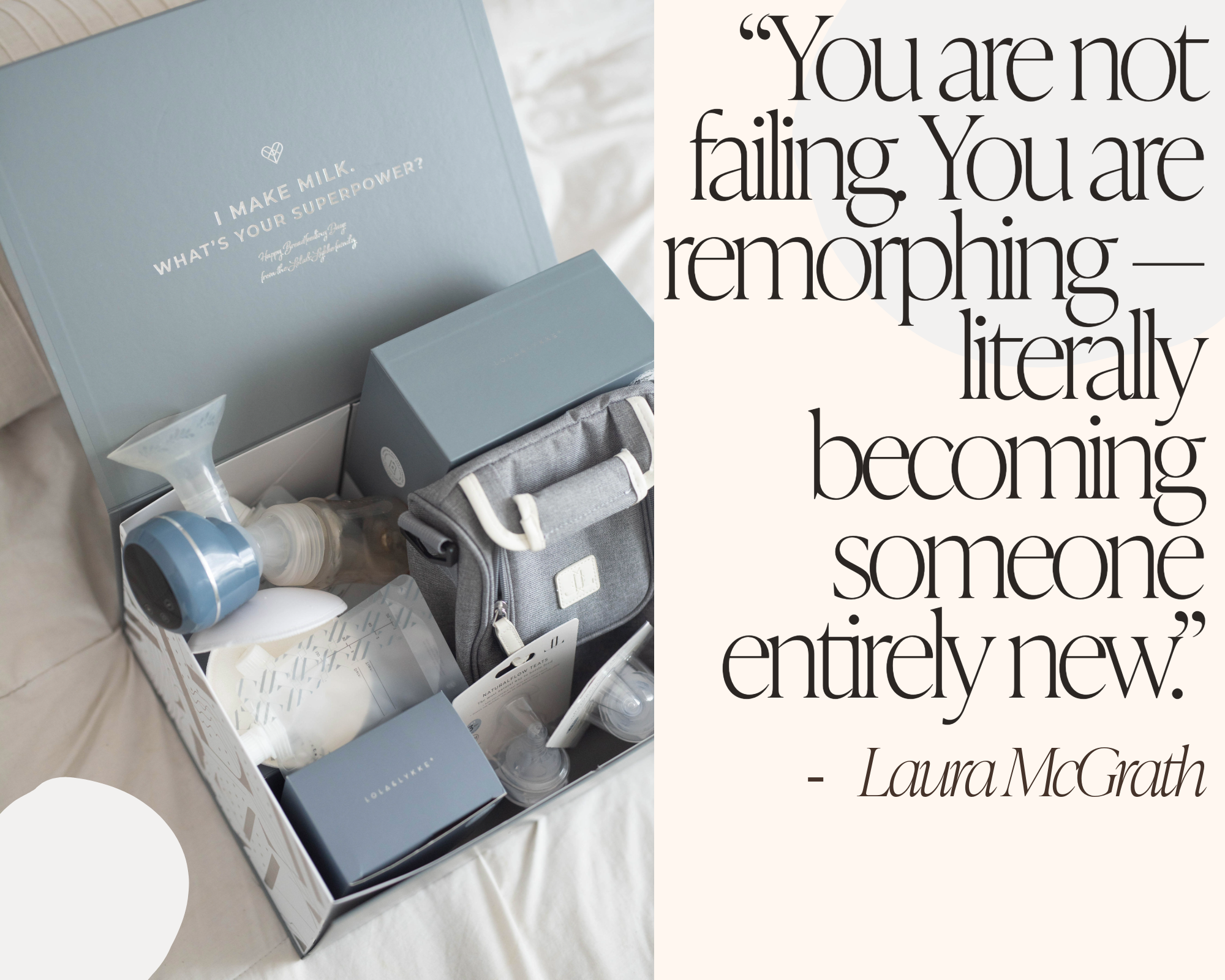
She uses a word that feels exactly right for postpartum, even if it isn’t used enough: You are “remorphing”, becoming someone entirely new, and that takes time.
The softness doesn’t dilute the punch. It strengthens it. Because when the world tells mothers to toughen up, power sometimes looks like tenderness: the kind that helps you come back to yourself.

Images Courtesy of Lola&Lykke
DESIGNING FOR THE WHOLE WOMAN, NOT JUST THE “MUM” PART.
Because Lola&Lykke is a breast pump brand, it would be easy for this piece to stop at “here’s the product.” But Laura’s design philosophy is actually another argument for the theme: trusting your gut includes trusting that you’re still you.
When she talks about product design, the first question they ask is simple: does this meaningfully make a mother’s life easier?
But then she goes deeper: so many motherhood products are clinical, joyless, or designed as if women should leave their identity at the door when they become mothers. Lola&Lykke reject that, insisting that a mother remains the same intelligent, stylish, discerning woman she was before pregnancy, just with less time and even less energy to compromise. And that’s not a superficial point. It’s about dignity.
Laura frames function and aesthetics not as a trade-off, but as a non-negotiable: products should work brilliantly and look beautiful, because motherhood can already make you feel wrecked, and the last thing a woman needs is a product that reflects exhaustion back at her.
Design, in her view, can be a kind of emotional support: not in a performative “self-care” way, but in a quiet, everyday way that says: you didn’t disappear.
And if you’ve ever felt the strange grief of becoming “mum” before you’ve had time to integrate who you are now, that reminder matters.
TRUST YOURSELF, NOT THE NOISE. AND ASK FOR WHAT YOU DESERVE.
If you take one thing from Laura’s story and philosophy, let it be this: you are not struggling because you’re not good enough. You’re struggling because the world wasn’t designed to support mothers properly and we’ve normalised that failure for far too long.
Trusting your gut as a new mother doesn’t mean you’ll never feel uncertain. It doesn’t mean every decision will feel clear. It means remembering that you are an intelligent individual living inside your own reality, and that you’re allowed to choose what works for you.
It also means recognising when the problem isn’t you, it’s the lack of support around you.
Laura’s closing sentence for mothers in the first weeks postpartum is beautifully simple: you are enough, just the way you are.
Sometimes the most radical antidote to noise is that kind of truth.
Images Courtesy of Lola&Lykke
TRUST YOURSELF, NOT THE NOISE. AND ASK FOR WHAT YOU DESERVE.
Motherhood asks you to step into the unknown while the world tells you it should feel natural. It tells you your body knows what to do, that instinct will guide you, and then it leaves you largely alone to discover the reality is something altogether different.
The truth is, no one walks into the fourth trimester fully prepared, because nothing can fully prepare you. But that doesn’t mean you are lost. It means you are human.
And in the space between what you were told and what you’re living, there is something worth protecting: your own knowing. Not the knowing that comes from certainty, but the quieter kind, the one that tells you what you need, what isn’t working, and when to ask for more.
Healthcare systems and society won’t always meet you there. They weren’t, for the most part, built with you in mind. So don’t wait to be cared for. Advocate for yourself. Trust what your body tells you. Demand better from the systems around you.
And that brings us to the heart of it: on the days when the noise is loudest, return to this: you are the expert on your own life. That has always been enough, even when the world forgot to tell you so.
Follow Lola&Lykke on Instagram Here. Visit Their Website Here.